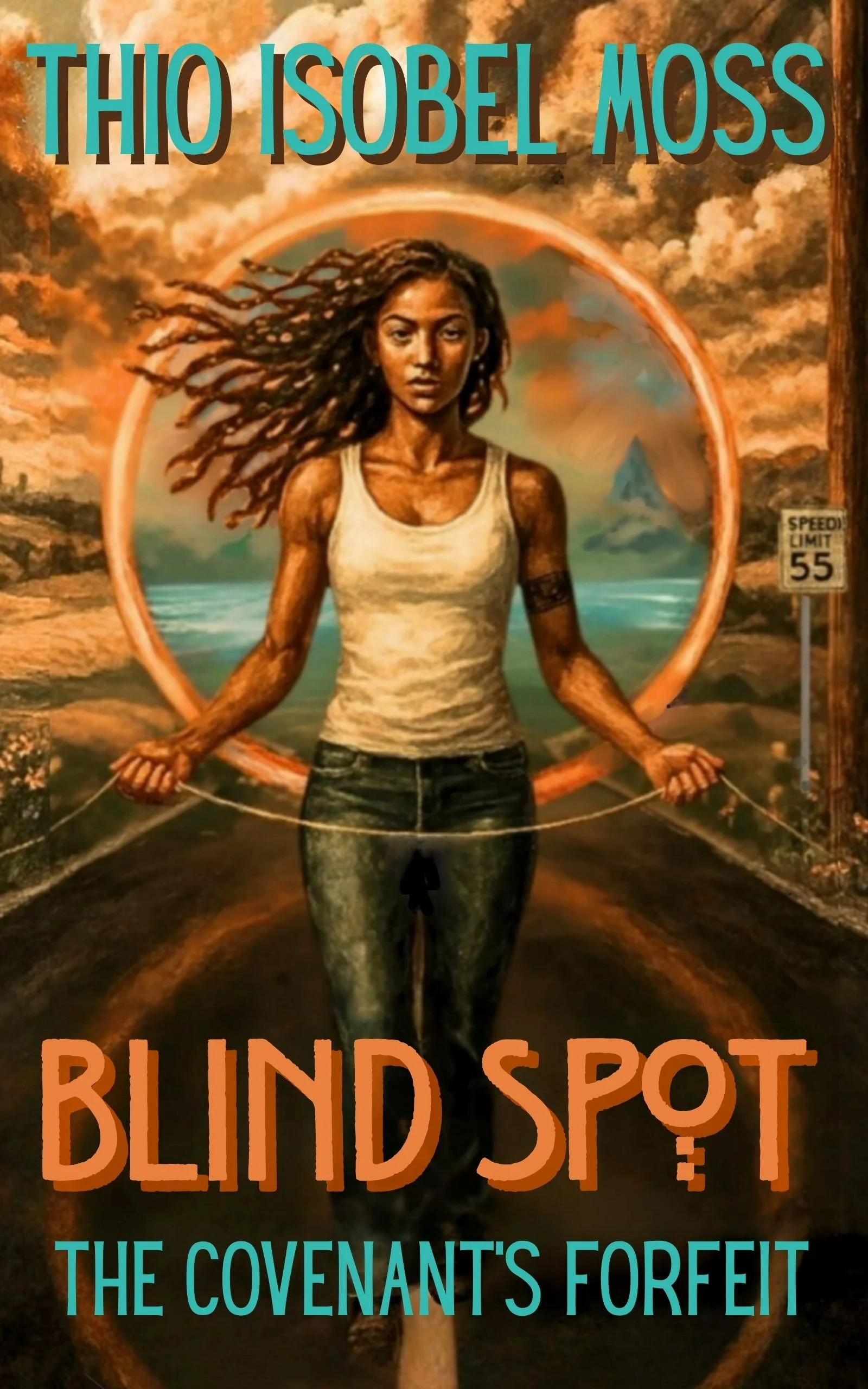
I recently became aware of a book club reading Blind Spot, and after I stopped squealing, I put this together:
Themes:
1. Do you think power changes people, or reveals who they already are? How is that illustrated in Blind Spot: The Covenant’s Forfeit?
2. Several characters must choose between personal loyalty and the greater good. Which choice stood out to you most?
3. The story explores secrecy versus truth. When do you think secrets are justified?
4. What does the story suggest about trust — is it earned, given, or tested?
5. Were there moments where you would have made a different choice than the characters? What would you have done?
Story Structure:
6. Is the narrator trustworthy?
7. Did the narrative ever challenge or undermine a character’s perception?
8. Is Kenny the main character? Why or why not?
Did the stakes feel personal, global, or both? How did that shape your experience?
10. What do you think ultimately drives the story — survival, power, balance, or something else?
Worldbuilding:
11. Would you want to live in Kenny’s world? Why or why not?
12. How would life change if people learned that magic was real?
13. What part of Kenny’s world felt the most realistic to you?
14. If you had magic and it was illegal, would you practice it so that you could use it and hide well, or learn just enough so that you didn’t use it by accident?
15. How would magic complicate personal responsibilities?
Characters:
Which character seems the most trustworthy to you? Why?
Which character seems the least trustworthy? Why?
Kenny is often forced to act before she has all the information. Do you think she makes good decisions under pressure? Why or why not?
Is Kenny a hero or a traitor?
Which relationships in the story felt the most meaningful?
If you could give one character advice, who would it be and what would you say?
Big Picture Questions:
22. What message did you take away from the book?
23. How does the story explore how good intentions can still lead to harm?
24. What does the book say about belonging — is it defined by loyalty, choice, or circumstance?
25. How does the tension between personal needs and collective safety show up throughout the story?
26. Is it more important to prevent harm or to preserve freedom?
27. What does the book imply about forgiveness — is it strength, necessity, or risk?
28. What does the book suggest about living with uncertainty?
The author’s responses (Warning: spoilers ahead!):
Themes:
1. Do you think power changes people, or reveals who they already are? How is that illustrated in Blind Spot: The Covenant’s Forfeit?
Some of both. Kenny, O’Brien, and Dorrit are driven by personal missions, and they use their power in service of what they believe is the greater good. Many members of the Quorum, however, have held power so long that they’ve grown disconnected and fearful of losing it, equating power with survival and committing terrible acts to preserve it.
Power guided by logic, honor, and purpose can elevate someone. Ungoverned, it breeds fear and entitlement. Most of us aren’t purely good or bad — we’re shaped by circumstance. Too much power encourages indulgence; too little can foster bitterness.
I’ve worked in environments where lack of support changed my behavior for the worse, despite considering myself a kind person. When conditions improved, so did I. That experience reinforced the importance of balance.
2. Several characters must choose between personal loyalty and the greater good. Which choice stood out to you most?
The one that stays with me is when Eli confronts Enid. He knows he’s succeeded in his purpose, but things aren’t going the way he planned. He feels like he failed. Enid has a choice; she can recognize that he is a child given a responsibility that would cripple most adults, and did what he thought was right, or she can resent him for damaging people that she loved in ways they do not yet understand. It’s an awful thing, but I agree with her choice.
3. The story explores secrecy versus truth. When do you think secrets are justified?
As with power, truth requires balance. Some systems cannot operate if everyone must know and approve of every detail. On the other hand, no fair system is ever created without a sufficient degree of transparency. Kenny, out of fear and a degree of self-loathing, makes a mistake early on and allows it to continue unchecked. Toward the end of Blind Spot, it’s time to pay the piper and fix it, which she does in part. Spoiler: it is not enough.
4. What does the story suggest about trust — is it earned, given, or tested?
Part of Eli’s self-assigned mission is to help Kenny realize that she can trust Dorrit. The variables are tweaked so that Dorrit has an opportunity to earn that trust. Even afterward, Kenny continues to have doubts, but accepts the risk it poses to her person. Trust, therefore, is a continuum; it can be given but will only endure if testing continually proves it. It can be earned, but again, it must continue to pass continual tests.
5. Were there moments where you would have made a different choice than the characters? What would you have done?
Absolutely! For one, I would not be the representative for the Sheta Djew. I would likely work on the Mulberry in Communications or Logistics. I’d want to do my bit, but no one’s survival should ever depend on my physical abilities and decisions made under pressure. If I had years of training and healed joints, I might learn to be an operative. Possibly. Probably not.
Story Structure:
6. Is the narrator trustworthy?
Sometimes it’s subtle, sometimes not, but the narrator is a character in the book and has an agenda of their own. Their opinions shine through, but they can be trusted inasmuch as their narration is sincere. They aren’t trying to trick the reader, but they are not unbiased.
7. Did the narrative ever challenge or undermine a character’s perception?
Yes, probably several times. In one instance, Veritas lies about having a sister to get out of an uncomfortable situation. Later, his memories indicate that he actually does have a sister. This is because, at that point, a backstory is being improvised and then adopted.
8. Is Kenny the main character? Why or why not?
Yes, although she generously shares her stage. O’Brien gets considerably less page time, but he has been conducting events for a very long time. His purpose is personal, but he is very motivated. Of the words left unsaid, he is certainly the star.
9. Did the stakes feel personal, global, or both? How did that shape your experience?
I wanted to weave the macro and micro together. Life is messy; the right decision for some can be devastating for others. Any question of significance is going to have an answer or solution that creates collateral damage. Again, we come back to…see the answer for 10.
10. What do you think ultimately drives the story — survival, power, balance, or something else?
Balance. Life is a thin line to walk while keeping integrity, survival, and hope intact; it requires constant self-examination and recalibration. If answers to the tough questions seem to come too easily, reexamine the source of those answers. Manipulation, even when unconscious or well-meant, is rife.
Worldbuilding:
11. Would you want to live in Kenny’s world? Why or why not?
As it is, no. There is a lot of corruption – people who think they are entitled to tell others how to live or shame them for their differences. It’s not a kind world. On the other hand, I wouldn’t have written it if I hadn’t dreamed of having magic. However, magic could easily become the crutch that makes you lose confidence in your own abilities. Easy solutions are so often our downfall.
12. How would life change if people learned that magic was real?
Former enemies would become allies overnight, even without a meeting to formalize it. Fear would drive groups together and crumble others. Many would embrace it, for good reasons and ugly ones. It would almost certainly end with a long and devastating war. I’m an optimist, so I think at some point the war would end in something less than self-extermination.
13. What part of Kenny’s world felt the most realistic to you?
A couple of parts, mostly those related to health, were written from personal experience, so those definitely. On a larger scale, the weighted votes in their governance seemed in line with human behavior, and the practical approach the Covenant is forced to take toward grieving their fallen with monthly funerals is pretty devastating.
14. If you had magic and it was illegal, would you practice it so that you could use it and hide well, or learn just enough so that you didn’t use it by accident?
This is a tricky one because I’m great at thinking, ‘Oh, remember not to mention XYZ,’ and then, almost immediately, mentioning XYZ. I’ve no idea why. Still, I think knowing how to cover your tracks is the safer path. Not learning magical housekeeping feels like playing Russian roulette.
15. How would magic complicate personal responsibilities?
Mental manipulation would always be a concern. Even without magic, it’s a concern. You wouldn’t be able to trust your senses. Pranks could have horrific consequences. There would be a much greater gulf between those who are considerate and those who are self-centered.
Characters:
16. Which character seems the most trustworthy to you? Why?
This is a bit of a cop-out, but Eli, simply because he’s a child. He is still very much driven by impulse and selfishness, as everyone is, but he hasn’t learned to hide it as much. He is well-meaning and hasn’t built up so much anger that it overrides his inherently earnest nature.
17. Which character seems the least trustworthy? Why?
Oh, look! A squirrel!
18. Kenny is often forced to act before she has all the information. Do you think she makes good decisions under pressure? Why or why not?
She is effective, but reckless. Generally, she’ll take the lion’s share of risk, but she’s influenced by a fairly dark opinion of herself. Without therapy, she would be too unpredictable, and on some level, she’s aware of that. She would be much better after a long sabbatical with more intense therapy.
19. Is Kenny a hero or a traitor?
Yes.
20. Which relationships in the story felt the most meaningful?
For me, personally, O’Brien’s relationship with his farsight abilities. Of the human relationships, Kenny’s with Kuwako and O’Brien’s with Dorrit are neck and neck.
21. If you could give one character advice, who would it be and what would you say?
I’d love to tell Kenny to have all combat operatives and Covenant leaders to take regular sabbaticals. They would likely live longer.
Big Picture Questions:
22. What message did you take away from the book?
In writing Blind Spot, I felt like I accomplished maybe eighty percent of what I intended to do — not in the page count, but in narrative ambition. That said, I also think I stopped at the right place. Hopefully, the message is an endorsement for balance and that all decisions carry weight.
23. How does the story explore how good intentions can still lead to harm?
Kenny knows something needs to change, and the only card she sees available to play may not only change who dies, but also how many — and not in the ratios she’d prefer. It is a devastating choice. If things had been different, the responsibility she would have carried would have destroyed her — and all she wants is to live in peace.
24. What does the book say about belonging — is it defined by loyalty, choice, or circumstance?
There is no one-size-fits-all. Kenny discovers that even in her healthy-seeming cadre ecosystem, there are big, dangerous problems. Loyalty can be warped, choices can be taken away, and circumstances can be manipulated. Belonging, which should be something everyone experiences and can rely on, is never guaranteed.
25. How does the tension between personal needs and collective safety show up throughout the story?
Kenny feels guilty even for the little bit of time she takes to play her banjo, but she has enough sense to know that sometimes it’s necessary. Most personal needs, beyond food, shelter, and hygiene, she treats as optional rather than required. Not healthy. She is loyal to the collective to a fault.
O’Brien has survived with his sanity arguably intact by balancing his needs with what must be done. It’s not easy and certainly does not come naturally to him, but Rena helps.
Dorrit, perhaps, has the healthiest perspective (which is still far from perfect), largely because he is part of Community and still sees practitioners as ‘other’, even while he exercises mercy. He knows he cannot rewrite the system and, if someone tried, the casualties would be astronomical. He does what he can.
26. Is it more important to prevent harm or to preserve freedom?
It comes down to balance. Absolute freedom isn’t freedom for everyone; some limits create the structure that keeps harm in check. No one wants drivers exercising total freedom on the highway — we’ve all seen the consequences. At the same time, meaningful freedom protects people from different kinds of harm.
When people feel unsupported or ignored, they stop supporting one another. I’ve seen this firsthand in toxic workplaces. A healthy system allows enough freedom to meet real needs while maintaining order. Without that balance, neither safety nor freedom lasts.
27. What does the book imply about forgiveness — is it strength, necessity, or risk?
It is all three. Forgiveness proves character. However, forgetting the offense is riskier (foreshadowing).
28. What does the book suggest about living with uncertainty?
Living with uncertainty is a certainty. Knowing everything would melt our brains; we’re not designed for it. Uncertainty, though, gives us confidence when we succeed and wisdom when we fail. It provides teachable moments, he he.
Please feel free to comment or email me your answers!
Happy reading!
