A Few Additional Thoughts on This Kingdom Will Not Kill Me by Ilona Andrews:
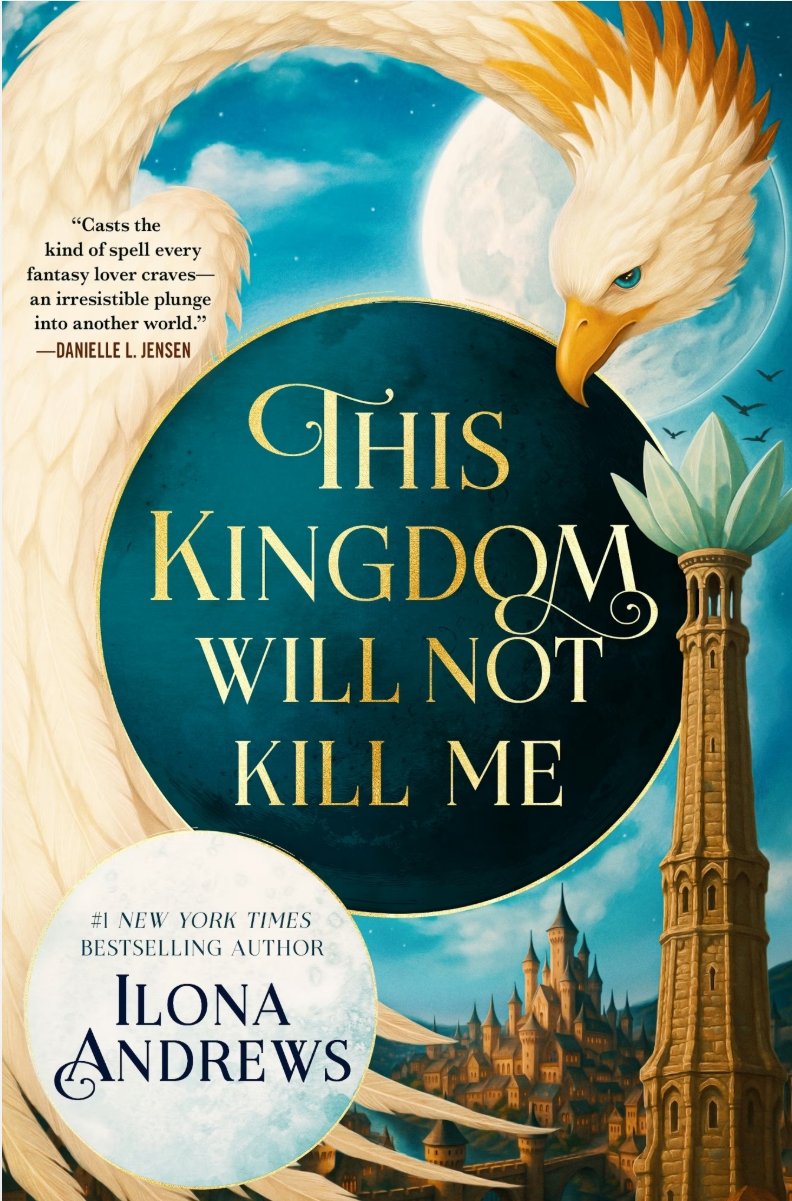
By Thio Isobel Moss
Warning: spoilers ahead.
Let’s start with some context.
I’ve been reading Ilona Andrews bibliography since around 2009, when I first discovered urban fantasy, and I’ve been happily obsessed ever since. I’m a card-carrying member of the BDH—original latte mug, not the newer metal ones.
I also followed the development of This Kingdom Will Not Kill Me on the blog from the beginning. I read every snippet, revisited them more than once…and then watched them disappear.
That matters because it shapes my perspective.
I loved the finished novel. I gave it five stars without hesitation. But having followed its earlier form, I found myself missing some of what had been left behind.
One of the most noticeable changes is the addition of the Garden of Soft Blossoms, which replaces an earlier, much humbler character who rented out a room. In the original version, that character’s history echoed Galiene’s in a grounded, almost brutal way that reinforced Maggie’s introduction to Kair Toren.
The Garden, while vivid and alluring, softens that edge. It’s beautifully done—but it feels closer in tone to the Temple of Desire in Sweep of the Heart than to the harsher, grittier entry Maggie originally had. For me, that tonal shift matters. I can appreciate the contrast it creates, but it doesn’t surpass the earlier version.
That sense of familiarity carries into the character dynamics.
The interplay between Maggie, Everard, and Solentine often mirrors the dynamic between Nevada, Rogan, and Augustine in the Hidden Legacy series—particularly in Burn for Me. There’s even a moment that echoes a line closely enough to stand out.
To be clear, this is a small portion of a large, ambitious book. It didn’t diminish my enjoyment in any significant way. But it was noticeable—and it raises an interesting question about the depths of reader knowledge. At what point does that familiarity with an author’s work start to shape, or even limit, the reading experience?
I recognized patterns: power imbalances — both social and physical, a protective (sometimes controlling) romantic lead, a secondary male character with his own agenda, and repeated blows to the trust between the heroine and hero. These are hallmarks of House Andrews’ storytelling. Here, though, I found myself wanting those elements to evolve a bit further.
That desire for evolution shows up most strongly in the romantic tension.
One of the absolute delights of this book is how Maggie describes the roles she could fill in this portal fantasy early on. That prediction closely mirrors what does happen to her — magic, ice-cold apex growly men falling all over themselves, begging her not to overexert herself. It’s delicious. It’s hilarious. That is exactly the kind of grace note I expect from Ilona and Gordon. Perfection!
Also, the firemen’s calendar and the “distressing lack of kittens”! I love their humor, but I digress.
There are multiple potential love interests — Doran Arven, possibly Estol Silveren, Reynald — but none quite generate the level of intrigue or competition I was expecting. The groundwork is there, but the emotional pull isn’t as strong as it could be.
I wanted confusion. I wanted to be torn.
I wanted a moment where I thought, I like this one—but wait, now this other one is making a compelling case.
Instead, Everard feels like the clear gravitational center. The others, while interesting, don’t exert enough pressure to truly challenge that trajectory. They’re not convincing Maggie or me.
Arvel bugs me. He isn’t given a lot of page time and has to work hard. I understand his attraction, but he’s moving fast! It’s off-putting, and fortunately, Maggie seems to agree. This could just be the setup, though. If he’s keeping secrets, my dismay could flare up into joy down the road.
Solentine stood out, too.
He enters the story with real presence—sharp, dangerous, unpredictable. There’s a brief period where he represents an active threat. But once Maggie accepts his contract (Hello, Austine; you’re in the wrong book!), that edge dulls. His role then quickly shifts toward ally, and while the logic tracks, the tension dissipates. He’s a hottie without teeth!
It’s a loss, because that sense of danger was what made him compelling in the first place.
That said, one of the book’s greatest strengths is Maggie herself—especially her self-awareness.
It’s also worth considering how the transition back to traditional publishing may have shaped the final product.
If some of the changes from the earlier version reflect editorial direction, they may explain the slightly softer tone and the smoothing of certain harsher elements. That’s not inherently a negative — just a different set of priorities at work.
And to be fair, most readers won’t experience the book the way I did. They won’t be comparing versions or tracking shifts in tone. They’ll encounter a rich, expansive, highly polished story — and likely love it.
All of this leaves me in an interesting place.
I still love This Kingdom Will Not Kill Me. I’m currently rereading it, partly for pleasure and partly to see what I might have missed. And I’m very aware that this is only the first book in what promises to be an impressive arc.
Many of the elements I’m questioning — Solentine’s softened edge, Everard’s fictional twin, Arven’s too-rapid interest — could be deliberate setups. If so, they position book two to deepen, complicate, and possibly overturn my current impressions.
I hope they do.
Because what I ultimately want is more: more tension, more uncertainty, more emotional conflict. I want secrets layered with genuine attraction, motives that remain murky until the last possible moment, and relationships that feel like they could tip in multiple directions.
The foundation is there. We’re left with a sharp sense of imminent danger. It just needs to keep pushing that edge.
I’m impatient—borderline feral—for book two. I need answers!
